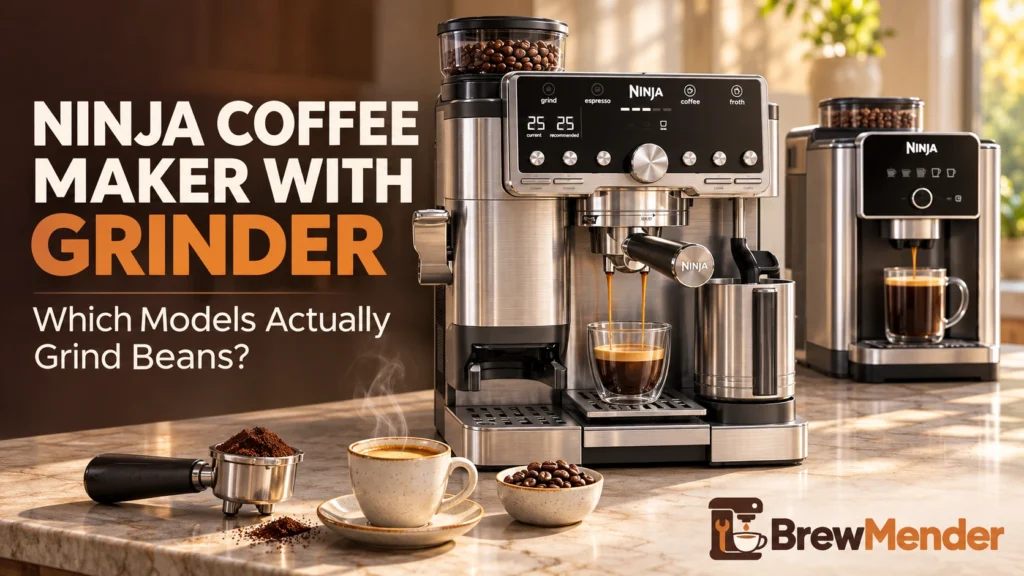
Looking for a Ninja coffee maker with grinder built in? Ninja sells six, and all of them are in its espresso lineup. In the US, the machines that grind whole beans are the Luxe Café Mini (ES301), Luxe Café Mini Plus (ES351), Luxe Café Premier (ES601), Luxe Café Pro (ES701), AutoBarista (AE1001) and AutoBarista Pro (AE1051). Ninja’s drip, DualBrew and pods-and-grounds brewers need coffee that is already ground. If you’re deciding between K-Cup convenience and Ninja’s pods-and-grounds flexibility, read our Ninja vs Keurig buying comparison. So the real choice is how much of the work you want to do and how much coffee you need from each brew.
This guide is based on Ninja’s US product pages and owner’s guides, plus published independent reviews. It is not a hands-on test.
- Six US Ninja machines, in three pairs, grind whole beans. Every other Ninja coffee maker uses ground coffee, pods or capsules.
- The four Luxe Café models are semi-automatic. The machine picks a grind and weighs the dose, but you move the portafilter, tamp and lock it in.
- The two AutoBarista models are fully automatic. You press a drink button, and the grinding, tamping and brewing happen inside the machine.
- None of them brews as much as a Ninja drip carafe. The largest single coffee brew is 12 oz on the Mini models, 18 oz on the Premier and Pro, and 40 oz on the AutoBarista. The DualBrew Pro’s carafe holds 60 oz.
- If you mostly drink drip coffee by the pot, a Ninja carafe brewer plus a separate burr grinder will usually fit better.
Ninja Coffee Maker With Grinder: All Six Models Compared
All six machines use a built-in burr grinder (a grinder that crushes beans between two grooved surfaces for a more even grind than a blade). They differ in what they brew, how many grind settings you get and how much you handle yourself.
| Model | Brews | Grinder | Your part | Milk | Buy |
|---|---|---|---|---|---|
| Luxe Café Mini (ES301) | Espresso, drip (hot or over ice) | 60 settings, suggested for you | Move portafilter, tamp | Manual steam wand | Check price on Amazon |
| Luxe Café Mini Plus (ES351) | Espresso, drip (hot or over ice) | 60 settings, suggested for you | Move portafilter, tamp | Hands-free, 3 presets | Check price on Amazon |
| Luxe Café Premier (ES601) | Espresso, drip, cold brew | 25 settings, suggested for you | Move portafilter, use assisted tamper | Hands-free, 4 presets | Check price on Amazon |
| Luxe Café Pro (ES701) | Espresso, drip, cold brew, hot water | 25 settings, suggested for you | Move portafilter, pull tamping lever | Hands-free, 5 presets | Check price on Amazon |
| AutoBarista (AE1001) | 10 one-touch drinks | 50 settings, set automatically | Press a button | Hands-free, 4 presets | Check price on Amazon |
| AutoBarista Pro (AE1051) | 13 one-touch drinks | 50 settings, set automatically; 2 swappable hoppers | Press a button | Hands-free, 5 presets | Check price on Amazon |
Paid links. Prices and availability change often, so check that the listing’s model number matches before you buy.
Sources: Ninja’s US pages for the Mini, Mini Plus, Premier, Pro, AutoBarista and Ninja’s fully automatic compare chart. Ninja’s Mini page lists 60 grind sizes; Tom’s Coffee Corner reports the same 60 on the Mini Plus.
One number is easy to misread: the Mini models have more grind settings than the larger Premier and Pro (60 versus 25). More settings means finer steps between sizes. It is not a quality rating.
If you drink regular coffee, serving size matters just as much:
| Model | Largest single coffee brew |
|---|---|
| Luxe Café Mini and Mini Plus | 12 oz (6, 8, 10 or 12 oz, per TechRadar’s Mini review) |
| Luxe Café Premier and Pro | 18 oz (6 to 18 oz in 2 oz steps, per Ninja’s US Premier owner’s guide) |
| AutoBarista | 40 oz drip coffee or cold brew, per Ninja’s AE1001 page |
Special editions and other model numbers you may see on listings are covered in the buying checks at the end.
Which Ninja Coffee Makers Have a Built-In Grinder?
Luxe Café Mini and Mini Plus
These are the compact pair. Ninja says they are 30% smaller than the Luxe Café Pro. It lists the Mini Plus at about 10 x 12.2 x 13.4 inches, with a 47 oz water tank and a 250 g bean hopper. Both brew espresso and drip coffee (Classic, Rich or Over Ice), with guided grinding and a built-in scale that doses by weight.
The only difference between them is milk. The Mini (ES301) has a manual steam wand, so you texture the milk yourself. The Mini Plus (ES351) froths hands-free with three presets: Steamed, Thin and Thick. Neither makes cold brew. Tom’s Coffee Corner also points out that the Mini portafilter has a single spout, so you cannot split one shot into two cups.
Luxe Café Premier and Pro
The Premier (ES601) and Pro (ES701) share the same 25-setting conical burr grinder, scale and hands-free frothing jug. Both add Ninja’s cold brew and cold-pressed espresso. The Pro adds a separate hot water outlet, a built-in tamping lever and a single-shot basket.
For the full feature-by-feature breakdown, see our Ninja Luxe Café Premier vs Pro comparison.
AutoBarista and AutoBarista Pro
These are Ninja’s fully automatic, bean-to-cup machines. Ninja’s Grind iQ system picks the grind size and dose from 50 settings, and you press the Grind iQ button to recalibrate when you switch beans. There is no portafilter to handle.
The AutoBarista (AE1001) has 10 one-touch drinks and four froth presets. The AutoBarista Pro (AE1051) has 13 drinks, adds an Extra Thick froth preset and comes with two swappable bean hoppers. Ninja also lists two user profiles on the Pro. Tom’s Coffee Corner names lungo, cortado and iced latte as the Pro-only drinks. It calls the second hopper the Pro’s main advantage, since you can keep regular and decaf beans ready.
Which Ninja Coffee Makers Do Not Grind Beans?
Most of Ninja’s coffee lineup does not grind beans. The labels on Ninja’s listings mean different things:
- Grinds whole beans: has a bean hopper and grinder inside. Only the six machines above.
- Grounds: brews coffee that is already ground, either bought ground or ground in a separate grinder.
- Pods or capsules: brews pre-filled single-serve pods.
- Frother: foams milk. It has nothing to do with grinding.
These machines get mistaken for grinder models:
- DualBrew Pro (CFP307). Ninja describes it as brewing “from your favorite coffee grounds or coffee pods,” with a fold-away frother. Its product page never mentions beans or a grinder. Its “9 grounds sizes” are brew sizes, not grind settings.
- Espresso & Coffee Barista System (CFN601). Ninja says it brews with espresso capsules and coffee grounds and includes a fold-away frother. Its product page lists no bean hopper or grinder. One Ninja category listing shows “4 Grind Sizes” for this capsule machine without explaining it, so do not read that line as proof of a built-in grinder.
- Single-Serve Pods & Grounds (PB051). The name says it: pods or ground coffee. At least one reseller listing calls it a “coffee maker and grinder,” which does not match Ninja’s own description.
- Specialty Coffee Maker (CM401) and drip brewers such as the Fresh Brew (CE451). These brew ground coffee into a carafe or cup. Ninja’s directions for the CE451 tell you to add ground coffee to the filter basket.
Ninja also sells a Coffee & Spice Grinder for compatible Ninja blender and kitchen-system bases. It is an accessory for those bases, not part of a coffee maker, and Ninja does not describe it as a burr grinder.
Ninja Luxe Café vs AutoBarista: How Much Work Do You Want to Do?
The Luxe Café guides you through each step. The AutoBarista does the steps for you.
A typical Luxe Café drink (based on Ninja’s US Premier guide):
- Choose the drink and size. Barista Assist suggests a grind setting.
- Lock the portafilter (with its funnel) into the grinding cradle. The grinder stops when the scale reaches the target weight.
- On the Premier, tamp the grounds for every espresso and for 16 oz or 18 oz coffee. For 6 to 14 oz coffee, a light shake to level the grounds is enough. The tamping rules differ on the Mini models, so follow your model’s guide.
- Move the portafilter to the brew head and start the brew.
- Froth milk separately: by hand on the Mini, hands-free on the other three.
- Knock out the used puck and rinse the portafilter and basket.
A typical AutoBarista drink:
- Choose one of the preset drinks. Ninja says you can adjust strength, temperature, size and froth style.
- The machine grinds, doses, tamps and brews internally. Ninja’s compare chart lists an automatic tamper.
- For milk drinks, the machine froths milk in its jug. According to TechRadar’s comparison, you still pour the milk into the cup yourself.
Cleaning differs too. TechRadar notes that the Luxe Café needs routine manual rinsing of the portafilter, basket and drip tray, plus steam wand purging. The AutoBarista has a removable brew unit, automatic rinse cycles and an interior fan, and Ninja includes brew unit lubricant in the box. TechRadar adds that fully automatic machines usually need more maintenance in general. For the Premier and Pro, our Ninja Luxe Café cleaning instructions cover the cleaning disc, grinder burrs, and steam wand care.
Reviewers flag one trade-off that both families share: water use. CoffeeGeek says the Premier’s purges send water to the drip tray, so the tray and tank need frequent attention. Tom’s Coffee Corner lists emptying the AutoBarista Pro’s drip tray about every five drinks as a drawback.
Which Ninja Grinder Coffee Maker Should You Buy?
Start with the drinks you make most, then your counter space:
- Small counter, you enjoy steaming milk by hand: Luxe Café Mini (ES301).
- Small counter, you want milk foamed for you: Luxe Café Mini Plus (ES351).
- You want cold brew, or coffee mugs larger than 12 oz: Luxe Café Premier (ES601).
- You want a hot water outlet for Americanos or tea, or a tamping lever: Luxe Café Pro (ES701). The Premier vs Pro comparison linked above covers this choice in detail.
- You want one-button drinks without handling a portafilter: AutoBarista (AE1001).
- Your household drinks both regular and decaf, more than one person wants saved settings, or you want the widest drink menu: AutoBarista Pro (AE1051).
- You mostly brew full pots of drip coffee: skip the grinder models and read the next section.
Independent reviewers agree on who the Luxe Café suits. CoffeeGeek’s Premier review calls it a strong fit for beginners who value convenience and drink variety, and a weaker fit for hobbyists who want full manual control. TechRadar’s comparison points to the AutoBarista Pro for people who put time and convenience first.
When a Separate Grinder Makes More Sense
A built-in grinder saves counter space and handles dosing for you. A Ninja brewer paired with a separate burr grinder is the better choice in four situations:
- You brew by the pot. The AutoBarista’s 40 oz is the largest brew of any grinder model. Ninja’s carafe brewers, such as the CM401 and the 12-cup DualBrew Pro, take ground coffee, so a separate grinder is the only way to brew a full carafe from fresh beans.
- You want to push espresso further. CoffeeGeek found the Premier’s dose fixed at about 17.5 to 18 g and judged its ceiling lower than some Breville machines for skilled users. For a direct look at the trade-offs, see how the Ninja Luxe Café Premier compares with the Breville Barista Express. Coffee Kev notes that very light, hard-to-extract roasts can be a struggle for integrated grinders.
- You want to repair or upgrade one part at a time. With an all-in-one machine, a grinder problem takes your whole coffee setup out of service. A separate grinder can be replaced or upgraded on its own.
- You sometimes use pre-ground coffee. Ninja’s US Premier guide says to put only whole beans in the hopper, never pre-ground coffee.
If none of these apply, the integrated models are the simpler route.
Before You Buy: Five Checks
- Match the model number. Some retailer listings label the Luxe Café Pro “fully automatic.” Ninja itself calls every Luxe Café model semi-automatic. Trust the model number and Ninja’s own label, and see the model-number note below this list.
- Check where it will sit. Ninja’s US Premier guide says not to run the machine under a wall cabinet or in an appliance garage, not to use an extension cord and not to plug it into an outlet below the counter. If your only spot is under upper cabinets, plan another location.
- Decide whether you need hot water. Among the Luxe Café models, only the Pro has a hot water outlet. Retail listings for the AutoBarista Pro show a hot water setting, but Ninja’s AutoBarista pages do not clearly list one, so confirm it on the listing if tea matters to you.
- Know what “cold brew” means here. Ninja markets its cold brew as rapid cold brew, not the long overnight steep the term usually describes. CoffeeGeek found the Premier’s version tasted like cold brew rather than iced coffee. The Mini and Mini Plus do not offer it.
- Plan for refills. These machines rinse and purge often. Expect to empty the drip tray and refill the tank more often than you would with a basic drip brewer.
Model numbers you may see: Special editions are the same core machine in a different finish. The ES771BK (David Beckham) and ES771SL (Jonathan Adler) are limited-edition Luxe Café Pro models, and the ES701STGD is a Stone and Gold Pro. Codes such as ES351GN, AE1051BL and AE1051BR are color variants, not new designs.
You may also see ES501 (sold in Canada as the Luxe Café Essential), ES651 or ES655CO on retailer listings or in Ninja’s accessory compatibility lists. Ninja’s US site does not currently have product pages for those, so check the listing’s specs carefully before buying one.